Metadata is more than a descriptive search and discovery tool for content. It also helps us to make connections between pieces of content when they are stored in a larger management system.
In the early days of the COVID-19 pandemic, Jessica Helfand published an essay entitled “Missing” that describes the sense of ambiguous loss we are all feeling at this particular moment in time. To illustrate this, she included a conversation she witnessed between her three students regarding an historic photograph:
Many years ago I was working with my students on an experimental project, adapting an early twentieth-century photo album as an interactive website, when we came upon a picture of a young soldier. He was photographed alone, in uniform, standing in an empty field. Below him, someone had written three words:
Taken in France.
We sat there staring at this image together for some time, searching for a narrative we could all agree upon—and couldn’t.
The photograph was taken in France, said one student.
No—he was taken prisoner in France, said another. He was missing in action.
No again, said a third. He was killed in France, and taken from his family.
Three students, three readings, three fully different, yet entirely reasonable explanations.
Jessica Helfand, “Missing”
The first thing I noticed when I read this passage was where the three students centered their discussion. There was no argument about who the photograph featured, what it was trying to depict, or why it was taken in the first place. What they focused on was the word “taken.” What did the word mean here? They didn’t know because they didn’t have any contextual clues that could either prove or disprove their theories.
In this example, the phrase “Taken in France” is so vague as to be almost meaningless and I can only assume there was no additional information for them to reference. The lack of verifiable information forced the three students to create their own meaning because the photograph was divorced from its context.
The difference between usable, valuable content and content that’s been stripped of all meaning is metadata. Metadata not only bridges that gap between the known and the unknown, it also provides us with the meaningful information we need to establish and preserve context.
Laying the Foundation for Context
We use metadata for many different reasons but I want to focus on two in particular.
The first reason deals with description. We include metadata that describes the content in as much detail as we can afford with the goal of answering a short list of questions: what, when, where, who, and how.
You’ll notice that I didn’t include why in that list. To best answer the question why, we need to place individual content items within a larger system that contains other content. By doing that, we can use other technical tools, such as ontologies, to make connections and create relationships between these items (if any).
In its article “What is Metadata?,” Ontotext lists a few reasons why we put so many resources toward including thorough metadata with our published content. I want to highlight one paragraph in particular:
When created and handled properly, metadata serves the clarity and consistency of information. Metadata facilitates the discovery of relevant information and the search and retrieval of resources. Tagged with metadata, any digital object can be automatically associated with other relevant elements and thus easy to organize and discover. This helps users make connections they would not have made otherwise. [emphasis mine]
Ontotext, “What is Metadata?”
This is the second reason why we use metadata: to make associations and connections between content. In fact, I believe metadata is at its most powerful when we use it for this reason because those connections can help us to form understanding.
However, that only happens when we can place the content within context.
Preventing Ambiguous Loss
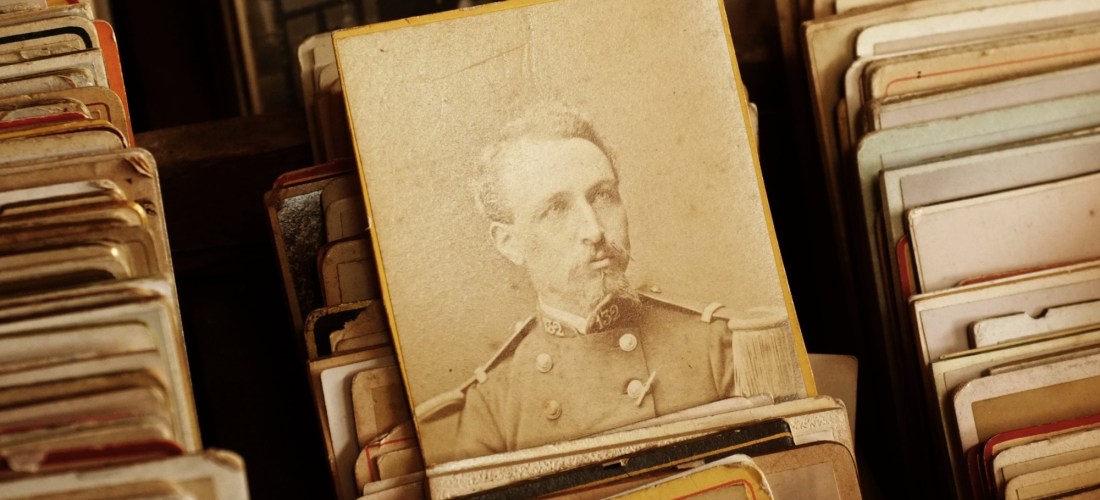
Back to the mysterious photograph that stumped Helfand’s students. What if the original photographer had provided more information about the soldier such as his name, his rank, or his unit? What about an exact date of when it was taken?
Imagine we had all that information, which we could then translate into machine-readable metadata. Imagine we could upload that information into a larger system that held other photographs from the same time period. Imagine that there exists other photographs of this soldier and the metadata attached to those photographs is also available in this system.
We could be celebrating a connection made instead of mourning an opportunity lost.
Not all information loss is preventable. Neither is it inevitable. If we have the technical tools to capture and preserve it, we should use them.
Photo by Mr Cup / Fabien Barral on Unsplash
 Sarah M. Kimes